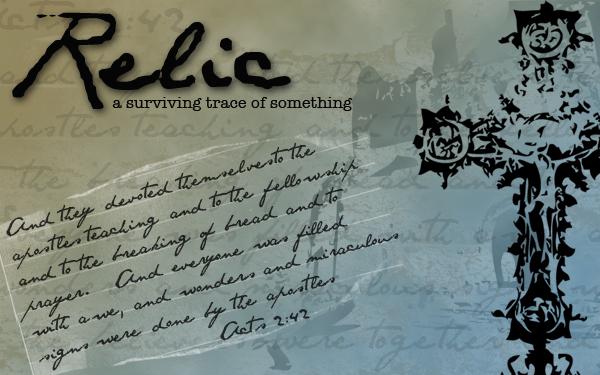
Last week Deeper started a new series called "Relic." In this series we're taking a look at the first Christian church, as outlined in Acts 2:42, and seeing what the basic elements of that church were and which, if any, have survived to today's church.
"All the believers devoted themselves to the apostles’ teaching, and to fellowship, and to sharing in meals (including the Lord’s Supper), and to prayer." - Acts 2:42 (NLT)
1) Studying Together: The most obvious parallel to this is a small group class or Bible study, where there is immediate feedback and ideas from all participants on each point in the study. It makes everyone feel as if they have a say and that their opinion matters, whether they're teaching or not. Beyond that, it is a good way to get personal questions answered when it comes to applying scriptural concepts to real life.
The second parallel could be, like GODencounters or your chosen weekly service, a time where the group at large comes together in a teaching setting. The catch, though, is that after the sermon is completed everyone doesn't just leave and go about their day. For example, last year at GE Pastor Bernie Anderson would preach a sermon about things he'd learned in his own spiritual walk, but afterwards there was time purposefully set aside for continuing discussion on what had just been talked about. Another idea was one that Pastor Jeff Gang used to do at the Deeper, which would be to create a bullet-point outline of his sermon that could be studied in a small-group setting. Those who participated in those studies felt personally enriched by the ability to go more in depth on the topic being presented up front. In a very real sense it personalizes corporate worship and foments personal interaction with those around you.
2) Fellowship: This is something that, for most of us, doesn't happen enough in the modern church (regardless of denomination). It is purposeful interaction with other people, be they the people in your Bible study group, the person sitting next to you in your pew, or your surrounding community. That last part is a key one. I don't believe that it is enough that we get to know just those "in the bubble" as it were, but to have fellowship with the surrounding community. Something so simple as doing yard work for an elderly person will both show the love of God to that person and help grow the bonds of fellowship within in the church community. As St. Francis famously said: "Preach the gospel at all times, when necessary use words."
3) Breaking Bread Together: Beyond just the ceremonial Communion, sharing a meal together is vitally important in the development of interpersonal relationships. It doesn't have to just be something elaborate like a large potluck, but maybe a few people getting together for a bite at Taco Bell randomly during the week. It cannot be a coincidence that the majority of first (and second and third) dates involve dining together, be it a full meal or just coffee. There is just a certain kind of bonding that goes on over a meal shared together, whether at the Olive Garden or in someone's home.
A couple of years ago a few people at the Forest Lake Church Deeper service tried a new concept in bread breaking. They had people sign up to be a either a host home or to be participants in a most unusual style of potluck: after the people had signed up, the leaders divided the participants up randomly. The idea was to allow the participants to meet people they didn't know before, and the response to such a small thing was overwhelming, and people genuinely were excited and wanted to do it again!
4) Praying Together: No spiritual group who wants to grow with each other and with God can do so without talking to God. Personal prayer is always important, but there is something to be said for praying unselfishly for others. Imagine a small group that prayed together regularly, for God to heal Phil's sick grandmother, that He help Jenny find a job, to thank Him for John and Sarah's new baby. It takes prayer to another level by making it intentional. Jesus prayed fervently for His disciples (John 15) and He encourages us to pray with and for each other. Additionally, praying together helps build another important part of a vibrant community, that of trust. When we start trusting each other with things that trouble us, there is a cathartic weight that is lifted. Something that seemed insurmountable alone no longer seems quite so impossible in the company of friends.
But how does one connect in a church as large as Forest Lake or a groups as big as Deeper? The best way, at least that I've found, is in small groups. Bible studies, basketball, grabbing some coffee with friends, there are many different ways to connect!
I would challenge everyone, as we go through this series and see how closely connected the original church was to find a small group or a couple of people to connect with. You'll be glad you did.
When the people are connected, we'll meet Pastor Derek Morris' definition of church:
"People who are passionate about being connected together in love with God at the center."


1 comment:
I heard these three people did a great job sharing about 242... Thanks Todd, Wilcley, Angie... you guys are amazing!
Post a Comment