Where Does the Name “Christmas” come from?
Christmas is the compounded word derived from “Christ’s Mass” which is derived from the Middle English Christemasse and Old English Cristes mæsse, a phrase first recorded in 1038. "Cristes" is from Greek christos and "mæsse" is from Latin missa.
Is Xmas Sacrilegious or Disrespectful?
In early Greek versions of the New Testament, the letter Χ (chi), is the first letter of Christ. Since the mid-16th century Χ, or the similar Roman letter X, has been used as an abbreviation for Christ. Hence, Xmas is often used as an abbreviation for Christmas.
The History of the Christmas Feast
The earliest reference to the celebration of the nativity on December 25 is found in the Chronography of 354, an illuminated manuscript compiled in Rome in 354. In the East, early Christians celebrated the birth of Christ as part of Epiphany (January 6), although this festival focused on the baptism of Jesus.
Christmas was promoted in the Christian East as part of the revival of Catholicism following the death of the pro-Arian Emperor Valens at theBattle of Adrianople in 378. The feast was introduced to Constantinople in 379, and to Antioch in about 380. The feast disappeared after Gregory of Nazianzus resigned as bishop in 381, although it was reintroduced by John Chrysostom in about 400.
Christmas during the Middle Ages was a public festival that incorporating ivy, holly, and other evergreens. Christmas gift-giving during the Middle Ages was usually between people with legal relationships, such as tenant and landlord.
The Reformation and Christmas
During the Reformation, some Protestants condemned Christmas celebration as "trappings of popery" and the "rags of the Beast." The Roman Catholic Church responded by promoting the festival in a more religiously oriented form.
In 1743, German Protestant Paul Ernst Jablonski argued Christmas was placed on December 25 to correspond with the Roman solar holiday Dies Natalis Solis Invicti and was therefore a "paganization" that debased the true church.
Dies Natalis Solis Invicti means "the birthday of the unconquered Sun." The use of the title Sol Invictus allowed several solar deities to be worshipped collectively, including Elah-Gabal, a Syrian sun god; Sol, the god of Emperor Aurelian; and Mithras, a soldiers' god of Persian origin. Emperor Elagabalus (218–222) introduced the festival, and it reached the height of its popularity under Aurelian, who promoted it as an empire-wide holiday. This day had held no significance in the Roman festive calendar until it was introduced in the third century.
The festival was placed on the date of the solstice because this was on this day that the Sun reversed its southward retreat and proved itself to be "unconquered." Several early Christian writers connected the rebirth of the sun to the birth of Jesus. "O, how wonderfully acted Providence that on that day on which that Sun was born...Christ should be born", Cyprian wrote. John Chrysostom also commented on the connection: "They call it the 'Birthday of the Unconquered'. Who indeed is so unconquered as Our Lord . . .?"
In Colonial America, the Puritans of New England disapproved of Christmas. Celebration was outlawed in Boston from 1659 to 1681. At the same time, Christian residents of Virginia and New York observed the holiday freely. Pennsylvania German Settlers, pre-eminently the Moravian settlers of Bethlehem, Nazareth and Lititz in Pennsylvania and the Wachovia Settlements in North Carolina, were enthusiastic celebrators of Christmas. The Moravians in Bethlehem had the first Christmas trees in America as well as the first Nativity Scenes.
What About Santa Claus?

The popular image of Santa Claus was created by the German-American cartoonist Thomas Nast (1840–1902), who drew a new image annually, beginning in 1863. By the 1880s, Nast's Santa had evolved into the form we now recognize. The image was standardized by advertisers in the 1920s.

Saint Nicholas of Myra is the primary inspiration for the Christian figure of Santa Claus. He was a 4th-century Greek Christian bishop of Myra in Lycia, a province of the Byzantine Anatolia, now in Turkey. Nicholas was famous for his generous gifts to the poor, in particular presenting the three impoverished daughters of a pious Christian with dowries so that they would not have to become prostitutes. He was very religious from an early age and devoted his life entirely to Christianity. In Europe (more precisely the Netherlands, Belgium, Austria and Germany) he is still portrayed as a bearded bishop in canonical robes.
Saint Nicholas (Greek: Άγιος Νικόλαος , Agios Nikolaos, "victory of the people") (270 - December 6, 346) is the common name for Nicholas of Myra, a saint and Bishop of Myra (in Lycia, part of modern-day Turkey). He had a reputation for secret gift-giving, such as putting coins in the shoes of those who left them out for him, and and thus became the model for Santa Claus, whose English name comes from the Dutch Sinterklaas.
The Christmas Story
John 1:1-5 (NLT)
In the beginning the Word already existed.
The Word was with God,
and the Word was God.
He existed in the beginning with God.
God created everything through him,
and nothing was created except through him.
The Word gave life to everything that was created,
and his life brought light to everyone.
The light shines in the darkness,
and the darkness can never extinguish it.
Luke 1:26-38 (NLT)
In the sixth month of Elizabeth’s pregnancy, God sent the angel Gabriel to Nazareth, a village in Galilee, to a virgin named Mary. She was engaged to be married to a man named Joseph, a descendant of King David. Gabriel appeared to her and said, “Greetings, favored woman! The Lord is with you!”
Confused and disturbed, Mary tried to think what the angel could mean. “Don’t be afraid, Mary,” the angel told her, “for you have found favor with God! You will conceive and give birth to a son, and you will name him Jesus. He will be very great and will be called the Son of the Most High. The Lord God will give him the throne of his ancestor David. And he will reign over Israel forever; his Kingdom will never end!”
Mary asked the angel, “But how can this happen? I am a virgin.”
The angel replied, “The Holy Spirit will come upon you, and the power of the Most High will overshadow you. So the baby to be born will be holy, and he will be called the Son of God. What’s more, your relative Elizabeth has become pregnant in her old age! People used to say she was barren, but she’s now in her sixth month. For nothing is impossible with God.”
Mary responded, “I am the Lord’s servant. May everything you have said about me come true.” And then the angel left her.
Matt. 1:19-25 (NLT)
Joseph, her fiancé, was a good man and did not want to disgrace her publicly, so he decided to break the engagement quietly.
As he considered this, an angel of the Lord appeared to him in a dream. “Joseph, son of David,” the angel said, “do not be afraid to take Mary as your wife. For the child within her was conceived by the Holy Spirit. And she will have a son, and you are to name him Jesus, for he will save his people from their sins.”
All of this occurred to fulfill the Lord’s message through his prophet:
“Look! The virgin will conceive a child!
She will give birth to a son,
and they will call him Immanuel,
which means ‘God is with us.’”When Joseph woke up, he did as the angel of the Lord commanded and took Mary as his wife. But he did not have sexual relations with her until her son was born. And Joseph named him Jesus.
Luke 2:1-38 (NLT)
At that time the Roman emperor, Augustus, decreed that a census should be taken throughout the Roman Empire. (This was the first census taken when Quirinius was governor of Syria.) All returned to their own ancestral towns to register for this census. And because Joseph was a descendant of King David, he had to go to Bethlehem in Judea, David’s ancient home. He traveled there from the village of Nazareth in Galilee. He took with him Mary, his fiancée, who was now obviously pregnant.
And while they were there, the time came for her baby to be born. She gave birth to her first child, a son. She wrapped him snugly in strips of cloth and laid him in a manger, because there was no lodging available for them.

That night there were shepherds staying in the fields nearby, guarding their flocks of sheep. Suddenly, an angel of the Lord appeared among them, and the radiance of the Lord’s glory surrounded them. They were terrified, but the angel reassured them. “Don’t be afraid!” he said. “I bring you good news that will bring great joy to all people. The Savior—yes, the Messiah, the Lord—has been born today in Bethlehem, the city of David! And you will recognize him by this sign: You will find a baby wrapped snugly in strips of cloth, lying in a manger.”
Suddenly, the angel was joined by a vast host of others—the armies of heaven—praising God and saying,
“Glory to God in highest heaven,
and peace on earth to those with whom God is pleased.”When the angels had returned to heaven, the shepherds said to each other, “Let’s go to Bethlehem! Let’s see this thing that has happened, which the Lord has told us about.”
They hurried to the village and found Mary and Joseph. And there was the baby, lying in the manger. After seeing him, the shepherds told everyone what had happened and what the angel had said to them about this child. All who heard the shepherds’ story were astonished, but Mary kept all these things in her heart and thought about them often. The shepherds went back to their flocks, glorifying and praising God for all they had heard and seen. It was just as the angel had told them.
Eight days later, when the baby was circumcised, he was named Jesus, the name given him by the angel even before he was conceived.
Then it was time for their purification offering, as required by the law of Moses after the birth of a child; so his parents took him to Jerusalem to present him to the Lord. The law of the Lord says, “If a woman’s first child is a boy, he must be dedicated to the Lord.” So they offered the sacrifice required in the law of the Lord—“either a pair of turtledoves or two young pigeons.”
At that time there was a man in Jerusalem named Simeon. He was righteous and devout and was eagerly waiting for the Messiah to come and rescue Israel. The Holy Spirit was upon him and had revealed to him that he would not die until he had seen the Lord’s Messiah. That day the Spirit led him to the Temple. So when Mary and Joseph came to present the baby Jesus to the Lord as the law required, Simeon was there. He took the child in his arms and praised God, saying,
Sovereign Lord, now let your servant die in peace,
as you have promised.
I have seen your salvation,
which you have prepared for all people.
He is a light to reveal God to the nations,
and he is the glory of your people Israel!”Jesus’ parents were amazed at what was being said about him. Then Simeon blessed them, and he said to Mary, the baby’s mother, “This child is destined to cause many in Israel to fall, but he will be a joy to many others. He has been sent as a sign from God, but many will oppose him. As a result, the deepest thoughts of many hearts will be revealed. And a sword will pierce your very soul.”
Anna, a prophet, was also there in the Temple. She was the daughter of Phanuel from the tribe of Asher, and she was very old. Her husband died when they had been married only seven years. Then she lived as a widow to the age of eighty-four. She never left the Temple but stayed there day and night, worshiping God with fasting and prayer. She came along just as Simeon was talking with Mary and Joseph, and she began praising God. She talked about the child to everyone

John 1:10-11 (NLT)
He came into the very world he created, but the world didn’t recognize him. He came to his own people, and even they rejected him.
Matt. 2:1-23 (NLT)
Jesus was born in Bethlehem in Judea, during the reign of King Herod. About that time some wise men from eastern lands arrived in Jerusalem, asking, “Where is the newborn king of the Jews? We saw his star as it rose, and we have come to worship him.”
King Herod was deeply disturbed when he heard this, as was everyone in Jerusalem. He called a meeting of the leading priests and teachers of religious law and asked, “Where is the Messiah supposed to be born?”
“In Bethlehem in Judea,” they said, “for this is what the prophet wrote:
‘And you, O Bethlehem in the land of Judah,
are not least among the ruling cities of Judah,
for a ruler will come from you
who will be the shepherd for my people Israel.’”
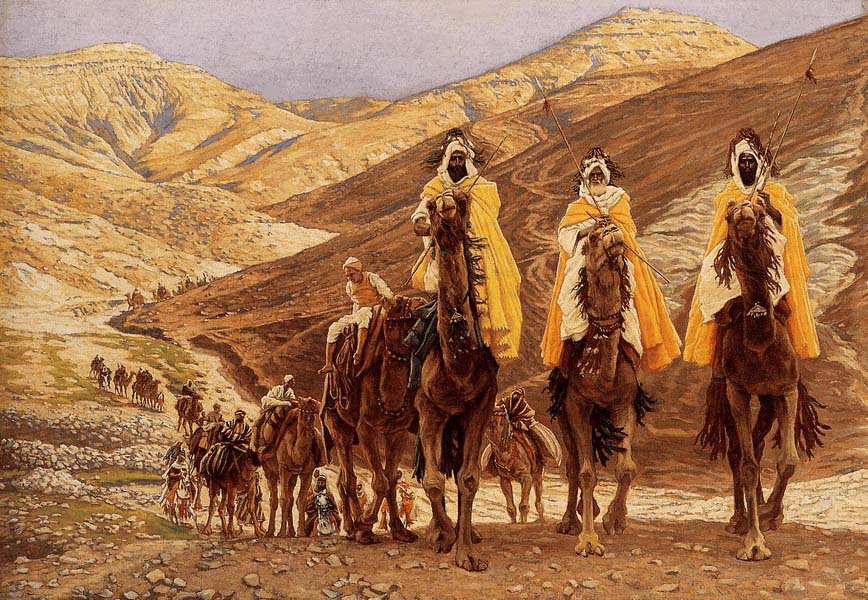
Then Herod called for a private meeting with the wise men, and he learned from them the time when the star first appeared. Then he told them, “Go to Bethlehem and search carefully for the child. And when you find him, come back and tell me so that I can go and worship him, too!”
After this interview the wise men went their way. And the star they had seen in the east guided them to Bethlehem. It went ahead of them and stopped over the place where the child was. When they saw the star, they were filled with joy! They entered the house and saw the child with his mother, Mary, and they bowed down and worshiped him. Then they opened their treasure chests and gave him gifts of gold, frankincense, and myrrh.
When it was time to leave, they returned to their own country by another route, for God had warned them in a dream not to return to Herod.
After the wise men were gone, an angel of the Lord appeared to Joseph in a dream. “Get up! Flee to Egypt with the child and his mother,” the angel said. “Stay there until I tell you to return, because Herod is going to search for the child to kill him.”
That night Joseph left for Egypt with the child and Mary, his mother, and they stayed there until Herod’s death. This fulfilled what the Lord had spoken through the prophet: “I called my Son out of Egypt.”
Herod was furious when he realized that the wise men had outwitted him. He sent soldiers to kill all the boys in and around Bethlehem who were two years old and under, based on the wise men’s report of the star’s first appearance. Herod’s brutal action fulfilled what God had spoken through the prophet Jeremiah:
“A cry was heard in Ramah—
weeping and great mourning.
Rachel weeps for her children,
refusing to be comforted,
for they are dead.”When Herod died, an angel of the Lord appeared in a dream to Joseph in Egypt. “Get up!” the angel said. “Take the child and his mother back to the land of Israel, because those who were trying to kill the child are dead.”
So Joseph got up and returned to the land of Israel with Jesus and his mother. But when he learned that the new ruler of Judea was Herod’s son Archelaus, he was afraid to go there. Then, after being warned in a dream, he left for the region of Galilee. So the family went and lived in a town called Nazareth. This fulfilled what the prophets had said: “He will be called a Nazarene.”
Luke 2:39-40 (NLT)
When Jesus’ parents had fulfilled all the requirements of the law of the Lord, they returned home to Nazareth in Galilee. There the child grew up healthy and strong. He was filled with wisdom, and God’s favor was on him.
John 1:14 (NLT)
So the Word became human and made his home among us. He was full of unfailing love and faithfulness. And we have seen his glory, the glory of the Father’s one and only Son.


No comments:
Post a Comment